William Beaver House Foreclosure

Started by kman
about 16 years ago
Posts: 2
Member since: Aug 2010

Discussion about 15 William Street in Financial District
Add Your Comment


Most popular
-
5 Comments
-
81 Comments
-
28 Comments
-
9 Comments
-
36 Comments
It won't in the short term... it's just that the building will be empty.
Also, at some point since the developer has defaulted and probably not paying the maintainance in the building then the quality of cleaning and fixing will go down and staff will be cut....
Also, the staff (doormen) in a condo building can become part of a union only after 70% is sold... which is far from happeneing in the William Beaver which is around 30% sold only, so they'll try to leave to a better building... they also might cut Amenities like pool hours or Gym and might start charging for events and reserving the roof or screening room... maybe it will affect the concierge service as well...
Why are the rents so high?
I'm looking for a studio and they're like astronomical!
Is there a link to the foreclosure? As a renter, I can say that they have begun to charge for the roofdeck for large parties reserved in advance. I was also told that the building has sold enough units so that the continual common charges being paid by owners cover the operation of the building as-is. Seems like they are not having an easy time renting out the ground floor space, as they want it to fit in with the image of the building (not like the McDonalds at Gramercy Stark). @ RR1, I am also told that many tenants who rented as the building began to open up fully (approx. 1 year ago) are having to move out because they have raised rents on some units considerably.
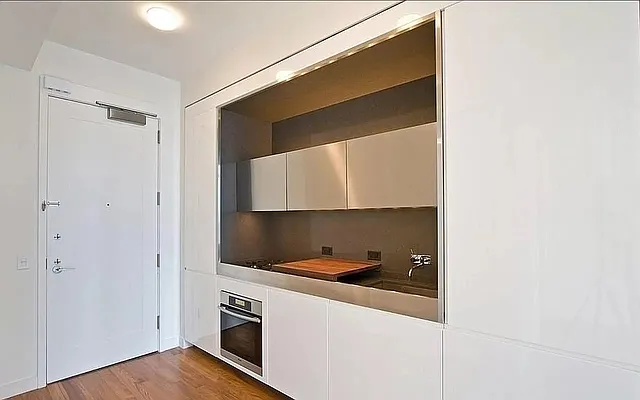
I can't believe those peek-a-boo baths didn't sell better.
those open bathrooms were such a stupid idea. and yeah, rent for a studio is 3k!
I believe things are much worse than you think. All the foreclosure papers are online on the NY eCourts website, so check them out. The developer has been in default since September 1, 2009, and the condo association is a defendant in the foreclosure "with respect to any lien for unpaid common charges."
By law, the developer is required to pay common charges for the proportion of the building it owns, even if they're unsold and empty. The developer still owns 75% of the building, so they're responsible for 75% of the building's expenses (about $4 million a year). When the till runs dry and the association can't take on any more debt, the current owners would have to QUADRUPLE their common charges to maintain the current level of service. If the owners can't all agree to pony up the cash, goodbye concierge, amenities, doormen – they could even turn off the heat. Don’t think that's so far out, NY local court shows a lawsuit from ConEd, though no details.
Prospective renters and those looking to renew should make sure there's a rider letting you out of your lease if (when) this happens. Otherwise your landlords could sue you to continue to pay the full term of your lease, because NY law only requires heat and hot water. Regarding that last point, the HVAC units are really heat pumps, so even if there is no hot water running through the pipes, they'll still blow out electric heat – you'll just be paying for it.
what happens when a condo goes into foreclosure?
all rental or up to the entity that buys it?
midtown: each situation is different. but you can generally assume that lender will want to rid itself of obligation as soon as possible. So, they will either lower prices on apts, or sell for cents on the dollar to a bulk buyer. If a bulk buyer (or a lender) cannot find buyers, they will rent out apts. If you are an owner, you can generally expect the value of your apt to go down.
From Today's Wall Street Journal:
A legal battle between Tamir Sapir, a former cab driver who made a fortune in New York real estate, and one of his lenders, a fund controlled by Blackstone Group, could turn on the mental state of the reclusive billionaire when he signed the loan documents.
Mr. Sapir's attorney argued in court last month that his client shouldn't be held accountable for money owed on contracts signed four years ago because Mr. Sapir was suffering from a "deteriorating mental condition," according to a New York Supreme Court transcript.
Attorneys for the Blackstone fund that is suing Mr. Sapir for $130 million say there's nothing to support this claim.
"There has never been, and still continues not to be, any evidence that [the fund] was aware of this alleged mental incapacity of Sapir in 2006, if it even existed," the fund's lawyers wrote in an Aug. 30 letter to New York Supreme Court Justice Bernard J. Fried that was reviewed by The Wall Street Journal.
In the suit against Mr. Sapir, the fund is alleging that he defaulted on a loan to develop the William Beaver House, a condominium in Manhattan's financial district. The suit says Mr. Sapir failed to repay the loan and interest that he personally guaranteed by the maturity date in November 2009. The interest rate on the loan is more than 18%.
Mr. Sapir, who is in his early 60s, is an émigré from the Soviet Union and a former New York City cab driver. He made his initial fortune in the 1980s by trading electronics with people in the Soviet Union for the rights to distribute Russian oil. He reinvested the profits in New York real estate in 1990s, becoming a billionaire by the following decade.
In 2006, he bought the Duke-Semans mansion on Fifth Avenue across from the Metropolitan Museum of Art for a then-record price in the city of $40 million. Earlier this summer, he sold that townhouse to Mexican billionaire Carlos Slim for $44 million.
Not all his company's real-estate investments have taken off. His company, the Sapir Organization, is one of the developers of the Trump SoHo condo-hotel that has been struggling to sell condo units. Recently, the Trump SoHo has been offering discounts to buyers in contracts who haven't yet closed. The developers plan to start offer direct financing to buyers soon, in an effort to finalize more sales.
Mr. Sapir's defense in the William Beaver case was first reported on the website Curbed. His attorney, Stephen Meister, initially asked the judge if he could make an off-the-record comment or seal a portion of the record, court transcripts show.
When the judge refused, Mr. Meister said he had seen medical reports from 2008 stating that Mr. Sapir was diagnosed with aphasia, a mental disorder that impairs the victim's ability to understand spoken or written language.
"He had not written anything other than signing his name for 10 years," Mr. Meister said in court.
The loan to Mr. Sapir originally was made by a fund run by GSO Capital Partners LP, which was acquired by Blackstone in 2008.
Mr. Sapir was acting under the advice of attorney Robert Ivanhoe when he pledged his personal guarantee for the fund loan, according to an affidavit from Alex Sapir, Tamir's son and president of the Sapir Organization.
Alex Sapir alleged in the affidavit that Mr. Ivanhoe had a financial stake in the development project and stood to gain personally from the project going forward.
"No disinterested and un-conflicted lawyer would advise Tamir to sign the Guaranty," Alex Sapir wrote in the affidavit.
Mr. Ivanhoe said in an email: "The allegations contained in this affidavit are without merit."
Mr. Meister said in court that he hadn't previously disclosed Tamir Sapir's mental deterioration because Mr. Sapir has debts on other properties and he was concerned that "other lenders may act in a predatory manner and try to accelerate due dates" if they learned of Mr. Sapir's condition.
The Blackstone fund's attorneys said in a letter to the judge that it was improper for Mr. Sapir to introduce the "new material" after the fund had called for a summary judgment.
The fund's lawyers also said in a letter that Mr. Sapir never attempted to "vacate the loan and guaranty as having been executed under mental incapacity."
Ira Salzman, an attorney who has worked on cases related to mental capacity for guardianship proceedings, said a contract can be declared invalid if one of the parties is shown to be incapable of understanding the contract or of making a rational judgment. Judges also consider whether the other party was aware of the mental incapacity when deciding whether to nullify a contract.
http://therealdeal.com/newyork/articles/andr%C3%A9-balazs-designed-william-beaver-house-to-go-partly-rental-under-its-new-owners-cim-group
William Beaver House to go partly rental
As The Real Deal previously reported, a number of units at the Beaver House, located at 15 William Street, were taken off the market earlier this year as Sapir became mired in a number of lawsuits over the building's finances. Currently, the condo is roughly one-third sold, with 111 units closed and, sources close to the building say, another 20-plus in contract.
Rodrigo Nino, president of Prodigy International, which is marketing the William Beaver House, would not say how much of the building is now expected to hit the rental market, but said in a statement that "with the inventory of units that we have available, some will be put on the market as rentals, while others will remain for sale."
He continued: "now that the William Beaver House is on stable ground with a new owner and on strong financial footing, we believe that buyers will once again strongly consider acquiring condominiums."
But will there be enough of them?
According to Elie Pariente, who runs the downtown residential brokerage Urban Marketing and has done a number of deals in the Beaver House, the new owners are likely to aim for between $1,200 and $1,300 per square foot for the condos, but it could take up to two years to sell off the remaining units at that price point.
"It's probably the smartest thing to rent out some of the units at the same time," Pariente said. "At least that way they can start generating cash flow right away… I have no doubt they'd rent it out very easily."
Meanwhile, with rumors now swirling that the building's future may not be entirely in sales, real estate attorney Adam Leitman Bailey was chomping at the bit to sue on behalf of a group of buyers seeking to renege on their contracts.
While he wouldn't disclose how many clients he has at the building, Bailey said that he is "waiting for the new amendment to come out so we have something to sue on."
By Alan Purkiss
Dec. 14 (Bloomberg) -- CIM Group LLC has bought debt from
iStar Financial Inc. on unsold luxury condominiums in William
Beaver House, a Sapir Organization development in New York’s
financial district, the New York Post reported, citing
unidentified people familiar with the matter.
The face value of the debt is $60.1 million, but the
newspaper said it was unable to ascertain the price CIM paid, or
whether iStar retains an interest.
Only 111 of the project’s 334 units have been sold, though
some may be under contract; CIM’s debt purchase covers 209
units, the Post said.
$1200-$1300/sq foot for sales? I think not. If they want to sell more than 1 or 2 apartments a month, they are going to need to drop the prices to well under $1000/foot. Still far too much inventory on the markeet in FiDi at that price and lower. And there is more to come as other lawsuits get worked out (25 Broad; Setai; 45 john). I'm calling it now - if any of these buildings want to move more than 1-3 apartments a month, they need to cut prices to $800-$900/square foot.
Ugliest building ever. The only benefit of living there is that, when you are inside, you don't have to see the facade.
Sure thing the resale market for the individual buyers has tanked. Condo ownership with no control and in a rental...
downtown: That's what puzzles me about FiDi. There seems to be no urgency whatsoever to sell in many of these buildings. It's almost like no one cares that a train wreck is coming up on the horizon.
thoth - I agree. It doesn't make sense. Developers are selling 1-2 apartments a month. They are all in default of their construction loans (some have received a work-out) so they are probably paying a really high interest rate (I'm not in real estate finance but I would guess the rate is around 15%; others in the know feel free to correct me). I think what will eventually happen is what happened in Miami. I've seen several stories on the news about it. The lenders foreclosed, took possesion of the properties and sold them at whatever they could get so they could cut their losses. In most cases, selling prices were less than half of the one-time asking price and in some cases, didn't ever cover the construction costs (let alone interest or any profit).
Take 75 Wall for example - roughly 345 apartments, about 140 sold. That means about 205 are left. Sure, they rented a few but that doesn't come anywhere near covering the carrying costs. The developer got an extension on its construction loan to May 2012. At the rate they are going, they will have sold another 30 apartments or so when the loan matures. In the meantime, they have accured tons of interest (remember, they have been paying interest on a construction loan since 2007 when they started the renovation and given they have only sld 140 or so apartment, probably haven't paid much back). At some point, the lender is going to say enough and kick out the developer and try to at least get some small portion of its investment back. Same story for lots of other developments.
i am hearing that 1br are being offered around 1k/sqft and 2br are around 11-1200/sqft, depending on desirability. So far, no changes to amenities and services to report, but we will see after the holidays what changes.
They are smoking if they think they will get anything close to that.
WBH is the end of an era.
downtown: Seems like the very definition of pretend and extend. My guess is that the lenders are o.k. with just holding on while interest rates are low, but will quickly move to foreclose and dump the units if they start moving up, since the opportunity cost of having capital locked up will become much more painful.
Looks like somebody bought the remaining units. I would love to hear what price per sq foot they paid.
http://streeteasy.com/nyc/closing/1785582
I wonder what will come of them.
wow- so what do you think?
rental?
The buyer bought 211 units (including 2 commercial units). Purchase price was $184 million. That averages out to $874,000/unit. It will be interesting to see if any money is made on these. $874,000 doesn't even cover the list price for a 1 bedroom let alone the 2-3 bedroom units. On the other hand, it's not like they will sell these things overnight so the carrying costs (including interest and common fees) will be high.
DT: Thanks for the info. It might be just the first domino to fall in the area - maybe some of the other buildings are next.
that "somebody" is CIM
From today's Wall Street Journal.... Maybe if they cut the prices another 25% people will think about buying. Asking $1.13MM for an 826 sq ft 1 bedroom is still insane.
By JOSH BARBANEL and CRAIG KARMIN
The distressed sale of the unsold apartments in William Beaver House, a 47-story condominium tower in the Financial District, has led a sharp drop in asking prices and refunds for unhappy would-be buyers.
The new owner took control of 209 unsold units at the new condominium building on William Street last month, as it was in the midst of a foreclosure.
The new owner, CIM Group, a California investment firm, has now filed an amendment to the offering plan cutting combined asking prices by $91.8 million, but indicated they might rent out some or all of the units instead.
The new filing shows the flip side of the normally painful foreclosure crisis, underscoring how distress can sometimes lead to lower prices, and the possibility of new opportunities for buyers.
In this case, CIM Group purchased $66 million in debt at a discount from a fund controlled by Blackstone Group. It then took title to the unsold units as part of a complicated deal in which it helped bail out Tamir Sapir, developer of William Beaver House.
The new documents, filed with the New York state attorney general's office, show official asking prices on many units are being cut by 21.5%.
In most new developments, lenders set limits on how much developers can cut asking prices, sometimes keeping prices unrealistically high. The amendment hasn't yet been approved.
In the plan, the asking price on a one-bedroom apartment on the 37th floor with 812 square feet was cut to $1.13 million from $1.44 million, reflecting the lower market values on the units.
But in the short term at least, the unsold units mostly are to be rented out to tenants, who would live among the 100 or so buyers who already own units in the development.
The amendment submitted didn't identify a brokerage firm that would sell the apartments.
Instead it said the CIM Group would sell its own apartments, and listed a telephone number in California to call.
The amendment will bring some relief to a group of 10 buyers, who had been working with a lawyer, Adam Leitman Bailey, and had planned to file a suit to get their deposits returned.
Mr. Bailey said that he has been hoping the need to file an amendment would convince the sponsor to return the deposits.
Last month, CIM made a trio of Manhattan real-estate deals with properties controlled by Mr. Sapir, head of the Sapir Organization.
Besides William Beaver House, CIM agreed to pay down about $85 million of senior debt held by iStar Financial for the downtown hotel-condo Trump SoHo.
The group also purchased a 49% stake in 11 Madison Ave., an Art Deco office building that is the U.S. headquarters of Credit Suisse, according to public property records filed Thursday. These filings show the 49% stake in the building's mortgage and equity results was valued at $469.4 million.
The William Beaver House, was an ambitious bet in the Financial District. The building was a bronze, brick and glass, structure constructed from the ground up on the corner of William and Beaver streets, when most apartments were converted from outdated office buildings.
It featured ads appealing to young single Wall Street types with ads of scantily clad women and a shower "big enough for three." But sales stalled in the downturn.
The building set a record price downtown, when a two-bedroom penthouse sold in 2007 for $3,512 a square foot.
But sales sputtered, and last spring foreclosure actions were begun
does that mean people that walked away get their deposit back or maybe get it back
Lets see, do I want to rent this or buy it?
In the plan, the asking price on a one-bedroom apartment on the 37th floor with 812 square feet was cut to $1.13 million from $1.44 million, reflecting the lower market values on the units.
If the rent is say, $3,500, why pay 1.13 for it. The decision to rent vs. buy is easy!
Rose Assocs. tapped to market Beaver House
http://www.crainsnewyork.com/article/20110107/REAL_ESTATE/110109896#
Not sure if that's a good or a bad thing, especially since it will likely go rental while the Beekman tower hits the market. A couple months ago the entire south-west half of the building was dark at night, which is probably where those 209 units are located.
Still not convinced pricing makes sense:
"While rents have not yet been finalized, Mr. Scaglion estimates that studios—larger than typical rentals because the building was originally built for condos—will go for around $3,000 a month. One-bedrooms will rent for $3,000 to $4,000 a month and two-bedrooms for $5,000 to $6,000 a month. Tenants will also have access to all the high-end amenities at the property which include a 50-foot lap pool and a health club, he added."
That sounds about 15-25% too high. It's the financial district, not tribeca.