20-year townhouse return

Started by George
about 4 years ago
Posts: 1327
Member since: Jul 2017
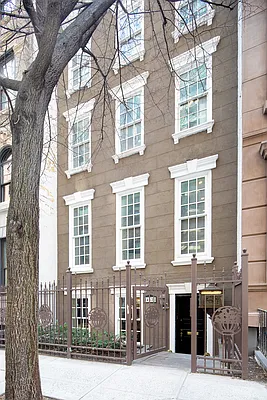
Discussion about 442 East 58th Street
Add Your Comment
Recommended for You
-

From our blog
NYC Open Houses for November 19 and 20 - More from our blog
Most popular
-
11 Comments
-
2 Comments
-
7 Comments
-
33 Comments
-
9 Comments
Recommended for You
-
From our blog
NYC Open Houses for November 19 and 20 - More from our blog
You can't live in a bond though. This is a home for your family, the bond is an investment. If you can't afford the home and continue to invest in bonds / stocks, you should probably consider another home.
Just my two cents.
Keith Burkhardt
TBG
George, Bring out the smart and savvy George and give us leverage (call it 3.5 to 1)and use benefit adjusted returns.
Imputed rent is typically the largest component of financial return to the owner, so you cannot really ignore it IMO. Nor the cost of updates, etc. Starting with that, this place had a serious reno ~20 years ago. That's evident from the pics, and according to this article it was a gut reno that took ~18 months:
https://www.nytimes.com/2002/08/25/realestate/habitats-east-50-s-a-couple-starts-over-in-4-story-town-house.html
Add that to the $2.44M purchase price, let's call it $3.6M-4.0M? Using your $4.8M exit, that's ~1%/yr. But then add (rent - taxes - upkeep) of $10K/mo, and that's another ~3%/yr. But it has probably sat empty for a third of that time (first on reno, then years waiting for sale) All-told, ~3-4%/yr on an after-tax basis.
Does that compare favorably to a ~3-4%/yr after-tax yield on a 20-year bond circa 2001? Not really. Against a 7% 30yr mortgage? Horribly. But I think it helps to have context.
In 2001, $4M would have been a lot of money to me, and I had a loooonnnnggggg road ahead of me. I would have rented an equivalent home and parlayed the $4M into $16M by now, laughing along the way at the puny $4.8M that is really a 25% loss on $4M accounting for inflation. But the buyers of this home were ~73 and ~60 at the time. One of them died 6 years ago at 88, the other is now 80. Of what use is $16M to them now?
>> You can't live in a bond though. This is a home for your family, the bond is an investment. If you can't afford the home and continue to invest in bonds / stocks, you should probably consider another home.
I look at this from a different lens. In my eyes, this was signing up to spend $32K/mo on a home circa 2001, separate from investments. If I didn't have giant wealth but was going to nevertheless spend $32K/mo circa 2001, I would have blown it on renting something much, much, much nicer. Even at age 73. Especially at age 73. YOLO. But for these fine folk, this is what made sense to them.
I think the Times article makes it clear that ROI was not a consideration in their purchase, based on their individual professions, background and their own statements. Also, mad props to the broker on her sales efforts.
"In starting over, they agreed to sell or give away nearly all of their furniture. ''I didn't like what he had, and he didn't like what I had,'' Ms. Packer said. Perhaps more important, she said, ''We just decided it would be our place.''
"Initially, they were looking for a three-bedroom apartment, to have space for visits from her daughter, his two sons and between them their four granddaughters."
"But then their broker, Midge LaGuardia of William B. May, suggested they would find more space for the same money in a town house."
>> I think the Times article makes it clear that ROI was not a consideration in their purchase, based on their individual professions, background and their own statements.
I can see why you say that. But their action w.r.t. sale tell a different story. It started 5 years ago with a price of $10.8M and $3K ppsf. The lack of the current listing's virtual staging made that ask all the more stark, dare I say delusional:
https://streeteasy.com/building/442-east-58-street-new_york/house
They may have not cared about the ROI in 2001, but it sure seems like someone did by 2017.
Just as MCR will tell you about the CO-OPS in the neighborhood, a similar, smallish buyer pool for townhomes. But for those who want to live on Sutton Place, no other place will do.
In my opinion, It's a wonderful lifestyle if you can afford it. I was fortunate to live in a brownstone in Chelsea for 10+ years. Great for entertaining, space among family members and having guests over. And then you have the private roof space and the backyard, but I understand it's not for everyone. When my father in law purchased it, I don't think he was overly concerned with roi. But everyone is different.
Am I the only one who thinks, 5.5M is actually a good deal for this already renovated townhouse in a fairly good parts of Manhattan and reasonable taxes??
Am I the only one who thinks, 5.5M is actually a good deal for this already renovated townhouse in a fairly good parts of Manhattan and reasonable taxes??
Am I the only one who thinks, 5.5M is actually a good deal for this already renovated townhouse in a fairly good parts of Manhattan and reasonable taxes??
Prp, Townhouses except for some prime+ areas trade like mid floor good condition 9 foot plus ceiling condos in those areas. The price does seem fair and the square footage doesn’t include finished cellar which many townhouse listings now are. You will see many UWS non park block townhouses priced similarly.
I haven't seen this listing in person, but the block sucks. This is basically the only TH and it's surrounded by tenement style apartments and giant towers. The bridge runs overhead (but is mostly blocked by The Sovereign) and the traffic can be awful nearby. On a proper TH block, the price might actually be good.
As for the financial return, my point is that 22 years of price appreciation produced almost nothing after inflation. Yes there's imputed rent etc that has to be considered, along with leverage. But we've gone thru two huge bull markets - the Dow has gone up 3.5x and the Nasdaq 5x since Nov '00 - and this property has barely kept up with inflation. I dunno, maybe now is the time to buy since the price has been beaten down so much?
George, What would a condo priced on that block per sq ft without view - say 3-5th floor nicely renovated with min 9 foot ceiling? I know there is probably no such condo on that block but hypothetically I can see it going for $1200-1400 per sq ft.
For a townhouse, the block is indeed pretty shitty.
That's the thing - townhouse blocks are worth far more than mixed blocks. I've never really compared to nearby condos bc the product is so different. I would comp this against THs in the east 60s near the hospitals or east 30s with the tunnel traffic. Sutton purists will howl with objections but most of them are dead or dying.
Here's a new condo you can compare it to and The sovereign is right there as well.
https://suttontower.com/
Sutton Tower isn't making their info easily accessible - good indication that sales are slow.
The Sovereign is listed at $800 to $1300 depending on the condition etc. At that price, the present TH should be perhaps $1000/ft or $3.6m. Prices in the area seem rather depressed.
Sovereign a coop. So add 20 percent premium for condo and adjust for condition and 25-50 percent of garden and 25 percent of below grade space as interior space. So call it 4200 sq ft at $1200 using a lesser quality post war building as a comp.
Btw, the townhouse is short a bathroom.
https://streeteasy.com/building/the-sovereign-425-east-58-street-new_york/7a
$875 per sq ft actual sale plus $100-150 per sqft reno premium (coop renovated as well) plus $100-150 per sq ft for much nicer building. Add on 15-20% condo premium. Less $100k short a bathroom. Gets you to $1250-1400 per sq ft range on 4200 sq ft.
Trying to compare 2 pieces of Real Estate that have absolutely nothing to do with each other by throwing a bunch of random adjustments into the mix is fool's errand. Real Estate is sui generis enough when things are of the same genus.
30, Location and block. There are no other townhouses there.
What would be your answer so that we can have a discussion?
There is no easy comp on this. Most of the nearby THs are multifamilies with insane taxes and sometimes RS tenants. Maybe the closest is 229 East 62nd Street which is listed at 6.9m and has a far more recent and tasteful renovation, is on a nice townhouse block with little bridge traffic, and is much closer to schools, subway, and services.
I think the present townhouse comes down to what someone is willing to pay, more than what comps dictate.
I definitely like 229 E 62nd St better than 442 E 58th St too, George, for all the same reasons. 442 E 58th St costs slightly less, but not enough to make up for the many, many warts. Here's the link for those who want to play along:
https://streeteasy.com/sale/1573873
Purchased in late 2021 for $6.5M. Listing to contract in 1 week, and the buyer immediately listed it right back after closing for $7.5M. Financed 75% with a 10yr IO loan at 2.25%, with a reset of SOFR + 2.75%, of course. After sitting on the market for ~6 months, chopped to $6.9M where it's been sitting for ~3 months. Tried its hand as a rental for a couple of months, but no takers at the $37.5K/mo ask.
If the market for this was $6.5M at the end of 2021, then I think the market for it now is lower. Which makes the market for 442 E 58th St plenty lower than $5.5M.
George>> But we've gone thru two huge bull markets - the Dow has gone up 3.5x and the Nasdaq 5x since Nov '00 - and this property has barely kept up with inflation.
Do you actually believe unimproved property values should exceed inflation by any material amount over the long-term? I never bought into that one, which has served me exceedingly well financially over the past ~20 years .
If 58th street (20x100, 3600 as per DOF) were be on 62nd street (17.8x63, 3708 sq ft as per DOF), 58th street is far superior townhouse due to larger back yard and wider footprint and square footage over more floors. But it is not. While I am not a townhouse buyer to live in, the biggest attraction of a townhouse is having a large backyard ideally with other townhouse backyards at the side and back. That is how you get your light and air and make the best use of you lower level kitchen.
Nada, I think inflation is generally what you get over 20+ years horizon and adjusting for 3x leverage returns becomes attractive when you are living there. I realize many areas/cities may get more than that due to factors like jobs, location desirability and real estate taxes. And in some locations, it may be cheaper to buy than rent after factoring in ownership expenses etc which adds an additional kicker to the returns.
300, I hadn’t realized 62nd St had a “short” lot. Both of these townhouses leave something to be desired, but 58th St leaves a lot more IMO.
On property values tracking inflation, that seems to be a more common view nowadays but it sure didn’t seem like that for much of the past ~20 years.
A TH back yard is nice but there are some gorgeous TH in the W Village that have little if any back yard and command $$$$. The 20' width on 58th is obviously nice but being surrounded by highrises kind of kills the vibe. Location location location, right?
Should land appreciate faster than inflation? Of course. There's a finite supply of land and a growing population.
Farmland prices 1912-2022 exceeded CPI by around 1% per year:
https://extension.missouri.edu/publications/g404
Home prices by 0.7% and building costs by 0.8%:
http://www.econ.yale.edu/~shiller/data/Fig3-1.xls
Is it that you think the rate is higher, or that 0.7%-1% per year is material?
If the real estate taxes were to only grow by inflation, yes the land can grow by more than inflation. But NYC real estate taxes in Manhattan for existing stock have gone up more than inflation from what I have seen. New developments start with much higher taxes if not abated and don't go up as much.
Nada, 0.7% is material with 3-4x leverage but individual locations variation is far higher. Ask people in Detroit.
$1 compounded over 100 years at 3% becomes $20. Compounded at 4% becomes $55. A little difference compounded over a long time becomes a huge difference.
300, the 0.7% is a national statistic over 110 years, not NYC-specific. So whatever you think is going on with NYC taxes specifically, it’s not in that 0.7% number.
Indeed. Individual city and location variations are huge. NYC stuffy prime UES coops vs BK townhouses would be a great example of disparity despite being in the same city.
George, I hear you on the compounding of an extra 1% over 100 years. Over 20 years, it only adds up to an extra 22%. It kinda sounded like you had bigger expectations than that from real price increases on a piece of RE like this.
The seller of 58th Street moved a little further north stuck to the east side, another Brownstone.
Which one?
58th Street townhouse
I meant "Where did the seller move?" I couldn't track it down myself....
Keith,
Are you sure about that?
Looks like they moved to a townhouse on 95th Street. Although I noticed that a few days ago, could have read that wrong.
My bad... Must have confused this with something else I was looking at.
+1 on 30yrs comment above that boils down to apples and oranges; but that does not mean I am not enjoying the discussion, so carry on.
Also +1 about Detroit. Nominal prices for breathtaking historical waterfront Tudors are not much higher than they were in the 80’s. If Inonada is feeling ambitious and wants a fun task, run the numbers on any given estate in Grosse Pointe; compare those numbers with some on 435 E52nd, and I think we’ll see some similarities.
And then look at what the market is for a closet in the West Village, and that “location, location, location” is undeniable. I find the price differentials between neighborhoods even within Manhattan astounding, let alone between Brooklyn and Manhattan. But then I understand when I look in the mirror because I put a premium on one block in Manattan that few appreciate. I love watching those properties that sit for years and then do actually find their buyer. There only needs to be one.
What if we said somebody rented the townhouse for $35,000 (maybe this number should be more? You tell me) a year averaged out over 20 years. They would have paid $8,400,000 in rent over that 20 year period.
And I know you guys are always comparing returns on a New York City apartment versus spx or something along those lines. My argument from Real world experience not everybody invests all their extra savings and some people avoid the stock market altogether.
My question to you then is, would you have been better off owning this for 20 years if you were not investing any potential rental savings/down payment in stocks.
Keith Burkhardt
TBG
I'm guessing 20 years ago this property would have rented for closer to $10,000 than $35,000
$35K/mo for this? Yikes!
I agree with 30yrs: ~$10K/mo circa 20 years ago sounds about right. Perhaps averaging out to ~$15K over the 20 years with increases over time.
Personally I think it would average out to more than 15K, especially if it started at 10K 20 years ago. I'll go with 20K averaged out $4,800,000 paid on rent over that 20-year period.
I remember rents being appx $4 per sq ft for basic rental in early 2000 after dot com bubble mix. So would put that at min $15k starting withlocations desirabilitdeclined since then and the rents overall
I remember rents being appx $4 per sq ft for basic luxury rental in early 2000 after dot com bubble mix. So I would put that at min $15k starting as that area was more desirable that time. Current market I am guessing is $20-25k plus as rents have gone up despite decline in the areas desirability. Of course all subject to illiquidity due to a non townhouse block.
It sounds like estimates of avg rent are between $15K/mo to $20K/mo. That puts 20yrs of rent between $3.6M to $4.8M. Let’s call it $4.2M and continue playing along with Keith’s game.
>> My question to you then is, would you have been better off owning this for 20 years if you were not investing any potential rental savings/down payment in stocks.
What is it you’re asking exactly? Let’s say the purchase + reno price on this circa 2001 was $3.8M. Let’s say $3M of this was financed. Mortgage rates back then were 7%. Do some refis along the way, averages down to 5%. So $3M * 5%/yr * 20yrs => $3M interest. At an average of $30K/yr in taxes * 20yrs => $0.6M/yr. Upkeep, services, insurance, etc. at $60K/yr (?) * 20yrs => $1.2M.
Add that all up, you get to $4.8M versus $4.2M in rent. If this sells for $5M-ish, that $0.6M hole probably turns into breakeven-ish after transaction costs.
So if one financed it, then one would have been no better off than stuffing cash into a mattress. Perhaps they would have enjoyed their experience better, but I don’t think they’d be in a different place financially.
>> My argument from Real world experience not everybody invests all their extra savings and some people avoid the stock market altogether.
I agree. Different people view their money differently, and that’s fine. Many people sleep better knowing their home is secure, their money is not at risk, etc. Those things are nice, but I sleep better if the aggregate of my net worth is invested in a way that yields high compounding returns at tolerable levels of risk.
Guess I just like the idea that after 20 years I will sell and get a nice big check. I'm a fan of 15-year mortgages and paying my mortgage off quickly. After 20 years of renting, possibly all I have is a box of receipts.
Just my simple way of looking at it.
I have a friend who used RE like that. She says she is incapable of not spending money sitting in her checking account. She probably couldn’t invest it gainfully anyways. So to her, the forced savings mechanism is critical.
Your simple plan on this TH would have indeed left her with a $4.8M check at the end. But she would have written $7.1M in checks to get there. $4.2M of this was a rent benefit, so really she would have paid an extra $2.9M to get out the $4.8M.
To my friend, this is a great plan. But really, the $2.9M => $4.8M “gain” is not really a gain at all once you account for inflation. All it really did was move the same purchasing power across time, which is fine for her.
It took me a long time to learn good savings and investment habits. Now I feel like I have a good balance, I own the home I live in mortgage free, and it's tripled in value since I purchased it. And through disciplined investing over the last 14 years I have a very nice nest egg.... relatively speaking.
I think a big part of this also depends on how much you earn and spend. Quite frankly I was never a big earner in New York City until I started the Burkhardt Group. A lot of that was by design, a lot of traveling, 9 years of touring and putting out records in the 90s. Traveling through Central America with a surfboard and a backpack...
If I would have bought an apartment in the early 90s after my divorce, and just held on to it, it would have served me very well financially. I guess some people call that forced savings. I always needed a roof over my head regardless of the lifestyle choices I was making, so would have been better off building equity in an apartment rather than just paying somebody else's mortgage with my rent. Over those approximate 35 years of calling New York City my home base..
I'm a blue collar kid, I have a lot of friends in New York, some that make what many would consider a pretty good living that live paycheck to paycheck, don't have a lot of extra money to invest. Or are afraid to put it into the stock market, since those extra funds are limited. The ones that bought houses or apartments early on are financially way better off than the ones that didn't.
I don't have a particular bias, I've lived an unconventional life since I left home at 17 to move to the LES, with a lot of twists and turns. So whatever works best for you regarding buying or renting your home.
Keith Burkhardt
TBG
Oh and just one more thing to add, I'm going to assume that the person that bought a townhouse in Manhattan has a decent income and continued investing their money (in something) after their purchase for the next 20 years.
This idea of "paying someone else's mortgage with my rent" is one I find incredibly simplistic and an emotional but not factual basis for ownership. I started this thread bc it's not at all obvious that the owners of this TH did better owning for 22 years rather than paying someone else's mortgage. It's almost certainly better to let someone else have the mortgage, taxes, assessments, fines, repair bills, and the rest of home ownership if the property barely appreciates in value.
I agree with you, George. People like to latch onto simple ideas, rules of thumb, etc. when it comes to finances. People don’t like doing the homework to see if it actually applies. As a small caveat to what you said, I think it can be better to own even when the home does not appreciate much IF the rent is high enough. Granted, that hasn’t been the case in NYC for a long time.
This graph from Miller Samuel illustrates the point nicely:
https://millersamuel.com/charts/manhattan-rental-to-sales-price-ratio-median-annualized/
In the 1990’s, this simplistic measure of rent/price floated around 10%, against the backdrop of 30yr mortgages at 8%. The next decade had it floating around 4%, against the backdrop of 6% mortgages. And the next decade had it at 4%, against a backdrop of 4%.
That all gets lost in the shuffle:
- The base yield of 10% vs 4%
- The +2% vs -2% spread relative to mortgages
- The benefit of price appreciation when yields compress
What you end up with is “would have been better off building equity in an apartment rather than just paying somebody else's mortgage with my rent”. That is certainly true, Keith would have been better off. But then some people turn it into an absolute.
Take it easy fellas, it's just an expression that my Neapolitan grandmother liked to say. I don't think it's a hard and fast principle. I'm speaking generally about home ownership, my argument isn't an anchored just to this house.
And you're right regarding this townhouse, probably not the best example. However it does demonstrate that people buy homes that they love, it is absolutely an emotional purchase from most people, and I mean that in the best of ways.
Like I said to each his own, you do you : )