building at 108 Wooster Street

Started by NYCAptHunter
about 16 years ago
Posts: 52
Member since: May 2010
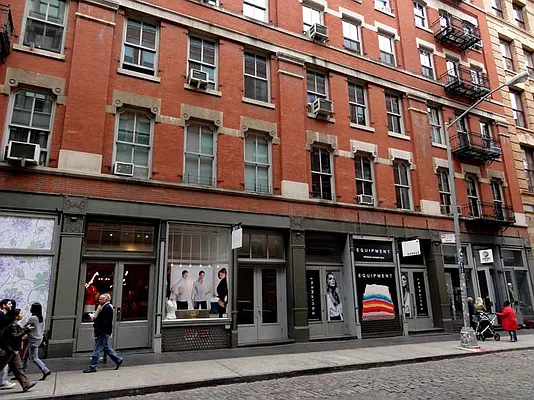
Discussion about 108 Wooster Street in Soho
Add Your Comment
Recommended for You
-

From our blog
NYC Open Houses for November 19 and 20 - More from our blog
Most popular
-
120 Comments
-
28 Comments
-
29 Comments
-
8 Comments
-
5 Comments
Recommended for You
-
From our blog
NYC Open Houses for November 19 and 20 - More from our blog
A corporation is a corporation. The difference here is that the corporation makes a surplus from its retail space, so the shareholders make more in income than they pay in maintenance.
The last two buyers, in 2007 and 2008, appear to have paid cash, but many of the other 14 shareholders have gotten share loans.
Deductibility is probably affected, but that's no big deal. If the finances work, they work.
The apartment on the block faces the back of the building ... a feature that is (annoyingly) not documented in most listings.
nwt -- how is deductibility affected?
I don't know. See http://www.taxalmanac.org/index.php/Sec._216._Deduction_of_taxes,_interest,_and_business_depreciation_by_cooperative_housing_corporation_tenant-stockholder
The co-op's financials and yearly tax letters will explain whether/how it varies from a standard co-op.
NWT - can you pls explain a little more. I'm not familiar of how one obtains a 'share loan'. My understanding is that most residential mortgage lenders will only lend to an apt building that is a coop or condo.
A look at the city legal database shows that this building has filed and is in the process of shifting over to a standard coop but is currently still an S-Corp. While several sales have happened, many appear to have fallen through assumedly because buyers didn't fully understand the implications of being an S-Corp and thus had trouble obtaining a mortgage. I think it's disingenuous (and perhaps illegal) to falsely advertise this building as a coop when it technically is not.
Also, NWT - a building does not have to be a corporation to pay out money from retail income. Coops do the exact same thing. The reason many buildings remained a corporation as opposed to a coop was because of the 80/20 law in effect prior to 2008. That is a max of 20% of building income could come from commercial income. This law has since been eliminated. It was a double edge sword for building owners that remained listed as an S-Corp - they received a higher commercial space income but lost out on potential buyers who cannot obtain residential mortgage financing.
**correction, typo, "a building does not have to be an S-Corp to pay..." obviously coops are also corporations.
When you borrow to buy co-op shares, you get a share loan, rather than a mortgage.
I'm pretty sure nobody would get as far as going to contract without knowing what it was they were buying.
Got it. So how does one obtain a residential share loan for purchase in an S-Corp?
ACRIS shows recent refi UCC1s filed by NCB, Emigrant, and TD Bank, so start with them or a mortgage broker.
Apple holds the underlying mortgage, so somebody there must be familiar with the building.
I tried TDBank, Apple bank and all the big commercial banks. NONE of them are willing to finance an S-Corp.
NYCAH, If I were you my next two phone calls would be to Guardhill Financial, which is a mortgage broker that is pretty good at tough loans, and to BNY Mellon, which will sometimes make nonstandard loans if you're a private banking client. I suspect that's the only way you're going to get this done -- move a substantial amount of assets to a Wall Street firm, and then get that firm to structure a loan against them. You may be looking at 40% equity, though.
ali r.
DG Neary Realty