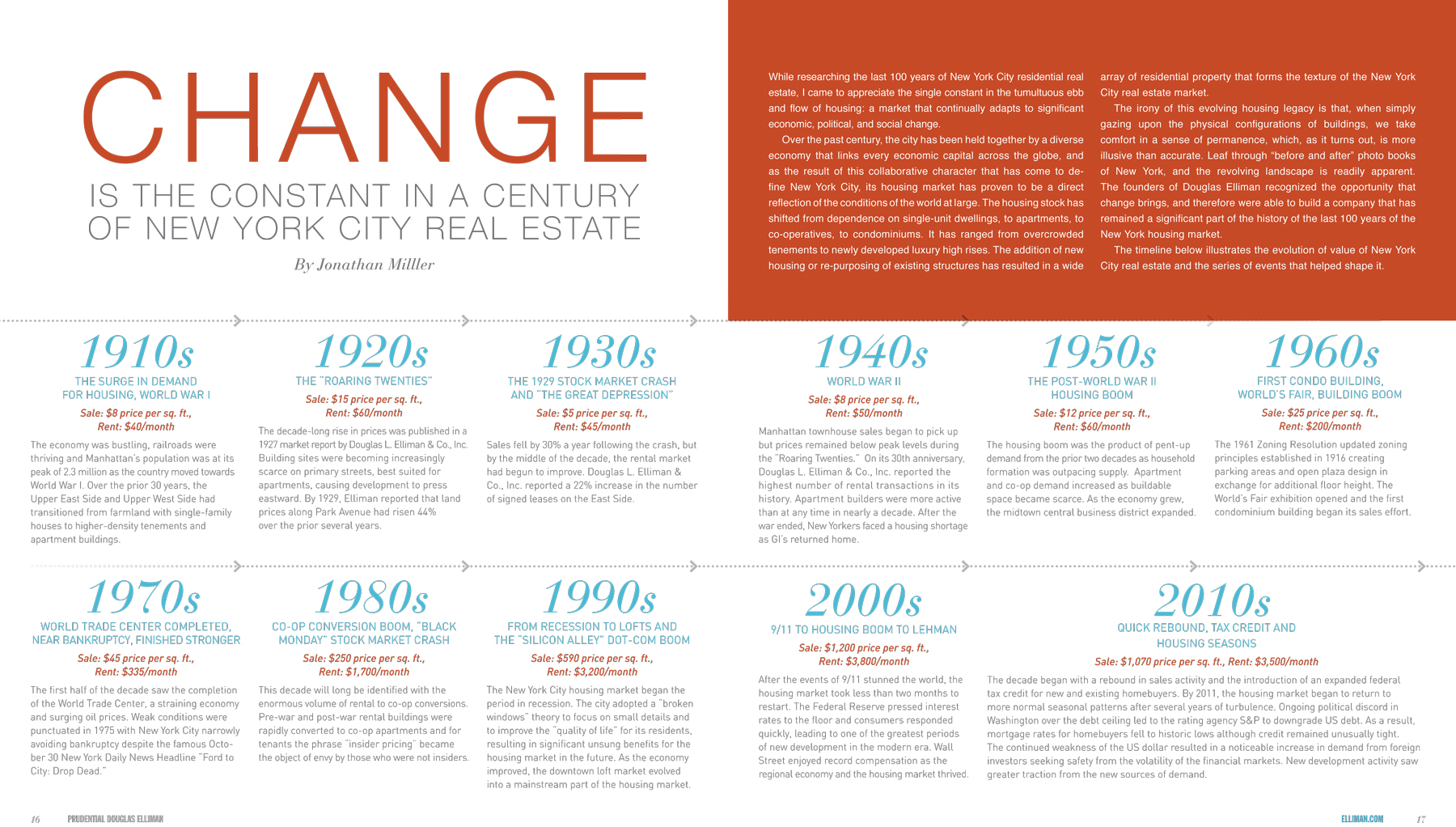
Interesting chart, I guess when it says New York City it means Manhattan.
From personal experience and taking the mid-point (or averages) of the decades, the 80's look low and the 90's look high.
Looks more like where the decades ended as opposed to an average for the decade.
Ignored comment.
Unhide
Response by marco_m
almost 14 years ago
Posts: 2481
Member since: Dec 2008
Manhattan RE will become even more dominated by management companies.
Ignored comment.
Unhide
Response by NYC10007
almost 14 years ago
Posts: 432
Member since: Nov 2009
Brooks2, you really are desperate for RE to bust in Manhattan aren't you. $590/sq.ft.? That would make myself along with every other owner in this city very sad...
When you look at this chart it does not give any of the anecdotal guidance to help explain why Manhattan RE has skyrocketed...and when compared to other parts of the country, only deflated slightly, rather than crashed. You can't compare Manhattan to the 80's and 90's to today. Then, you couldn't walk down the street after dark without the fear of being mugged. When the upper east side was still "move-in on up...". When no one who could afford a cab would consider taking the subway after 9pm. When you couldn't pass 10th Avenue without locking your car doors and fearing the windshield washers who came out of nowhere. When Bleeker street as actually Bleeker street, when it was cheap (and unsafe) to live in Tribeca....
It's an entirely different city now, more international than ever and better to compare with Hong Kong and Tokyo from a RE perspective than any other place in this country. I see a greater separation of quality and value going forward, where the crappy mid-century co-ops will continue to reduce in value, and there will be a growing spread in the premium that will be paid for upscale condos in good neighborhoods. $590 sq/ft.? Maybe for the crappy stuff, but highly unlikely that will be the norm. There will be no fundamentals to justify it, same way that's the case in your other astronomically expensive international cities.
Ignored comment.
Unhide
Response by Bill7284
almost 14 years ago
Posts: 631
Member since: Feb 2009
Thanks dealboy. NYC10007; I couldn't agree with you more. NYC and London always had similar highs and lows through the years and now both have nothing in common with their own countries. If we think NY is expensive now, just wait. Not looking foward to it.
Ignored comment.
Unhide
Response by PMG
almost 14 years ago
Posts: 1322
Member since: Jan 2008
My bewilderment with the sales frenzy that occurred in Manhattan residential property is that all apartments got bid up to somewhat comparable valuations without regard to ammenities or neighborhood. In commercial buildings, buildings are classified as A, B or C and neighborhood also obviously matter because commutes to from far flung locations where employees live matter. With residential buildings, people need access to schools, bars, restaurants, shopping, parks and transit, with various weights depending on their lifestyle. Unless you're in a freelance service business, you probably don't need to live in a location where you can get everywhere in the city in 20 minutes, although that's certainly convenient. You do care about your commute to work or to weekend escapes and getting your lifestyle needs met. I laugh when I read that classic 6s are out of style. Since when will being near schools, cultural institutions, restaurants, hospitals ever go out of style. I contine to predict that there will be more divergence in values among residential property as buildings and apt lines develop reputations and gather more trading value history. It's already happening to a larger degree.
Ignored comment.
Unhide
Response by dealboy
almost 14 years ago
Posts: 528
Member since: Jan 2011
The 80's look low b/c NYC was a hellhole shithole warzone in the 1980s. Oh, how people forget. There was a reason everyone got the F out of there to the suburbs in the 1980s.
Ignored comment.
Unhide
Response by dealboy
almost 14 years ago
Posts: 528
Member since: Jan 2011
> . I laugh when I read that classic 6s are out of style. Since when will being near schools, cultural institutions, restaurants, hospitals ever go out of style
Since always. Being old is not in style. No one under 40 gives a shit about those things!
Ignored comment.
Unhide
Response by RealEstateNY
almost 14 years ago
Posts: 772
Member since: Aug 2009
"The 80's look low b/c NYC was a hellhole shithole warzone in the 1980s. Oh, how people forget. There was a
reason everyone got the F out of there to the suburbs in the 1980s."
I guess you weren't there. Check the chart again, the prices went up the most in the 80's, 5 times that of the 70's.
The 60's and 70's were the bad decades for NYC when everyone began to flee for the suburbs, the 80's began the influx in that continues today.
Ignored comment.
Unhide
Response by financeguy
almost 14 years ago
Posts: 711
Member since: May 2009
RENY, dealboy:
According to the chart, nominal rents have slightly more than doubled since the 1980s. CPI has doubled since 1985, so most of that change is just inflation. Moreover, the median increase is probably higher than the increase for comparable units: the median rental unit is probably in better shape than it was in the 1980s.
Notice that rents haven't changed significantly in real terms even though the city has gotten richer. This is exactly what ordinary market theory predicts. Demand went up. As demand increased, developers provided more supply. Supply and demand balance, roughly, when rents allow developers to make a normal return. So over longer periods, rental prices tend to reflect development costs, which, in turn, usually track CPI pretty closely. (Over shorter periods, supply is relatively fixed, so sudden changes in demand can lead to abrupt changes in rents -- like after Lehman. But developers adjust within a few years, especially when demand is generally increasing over time.)
So the question is NOT why sales prices have doubled since the 1980s -- that's because of inflation and because the city is an easier place to live and incomes have gone up and quality of housing has gone up and the cost of development has gone up. Those real changes are all reflected in the rents.
The question is why sales prices went up 5 times instead of the 2x that rents went up. If prices had gone up along with rents, the median would now be around $520 psf (give or take a bit since the quality of the median sale has probably increased at a slightly different rate than the quality of the median rental).
The extra 3x is the bubble: people paying more than marginal cost because they expected to be able to sell for even more. But of course bubbles are unsustainable: if developers can sell for 2x costs of construction, renovation or conversion, they'll slowly find ways to increase supply. As the bubble reverses, bubble traders will dry up, reducing demand. People don't like to realize losses, but over time some won't have any choice and others will adjust and slowly, condo owners will decide to sell their investment units rather than rent to Inonada at a loss. As supply increases and hits a reduced, post-bubble, demand, prices will drop. Slowly.
These fundamentals create powerful pressures for rents and sales prices to converge towards the point where it is no longer profitable to convert a rental to a sale, which (as the sale of Stuy Town suggests) is likely in the vicinity of 8-12x annual rents for comparable properties, or somewhat more for medians (since the median rental is lower quality than the median sale).
Psychology can always overcome fundamentals in the short run, just as momentum is more powerful than gravity. But anyone thinking in terms of 5-20 years should assume that (real) prices will drop by half or so, most likely slowly and with a much smaller nominal drop, as supply continues to increase and bubble-inflated demand declines.
Assuming the NYC economy continues to prosper, the only way to avoid that drop is if the profit motive no longer motivates, or if development or conversion suddenly and permanently gets far more expensive perhaps by stronger tenant protection or zoning laws or shortages of materials/labor/capital that can't be overcome by innovation, or if a new irrational belief that NYC RE only goes up seizes the banks and the masses. Personally, I wouldn't want to bet on any of those; others may take a more pessimistic view of the micro-functioning of the economy -- LIC and several other regular commenters here seem to think Adam Smith was just wrong and we are doomed to a Lloyd George transfer of all wealth to the unproductive landlord class.
(In contrast, if the macro doomsayers are right and I'm wrong in assuming that NYC is going to successfully avoid a drop in high paying jobs, the RE market could drop well below fundamentals for decades: it is much harder for investors to reduce supply than to increase it. See Rochester 1980-date, or NYC 1930-1950.)
Ignored comment.
Unhide
Response by dealboy
almost 14 years ago
Posts: 528
Member since: Jan 2011
In other words, reversion the the mean.
Ignored comment.
Unhide
Response by Brooks2
almost 14 years ago
Posts: 2970
Member since: Aug 2011
The question is why sales prices went up 5 times instead of the 2x that rents went up. If prices had gone up along with rents, the median would now be around $520 psf (give or take a bit since the quality of the median sale has probably increased at a slightly different rate than the quality of the median rental).
So my stab in the dark-- of $590psf isn't that unrealistic--- a reversion to the mean..
Ignored comment.
Unhide
Response by Brooks2
almost 14 years ago
Posts: 2970
Member since: Aug 2011
Brooks2, you really are desperate for RE to bust in Manhattan aren't you. $590/sq.ft.? That would make myself along with every other owner in this city very sad..
btw- not desperate-- just realistic. I pay attention to a lot of fundamentals. The air is still coming out of the bubble. in 8 years we realistically could have the same rents with lower prices if incomes continue to go down and the employment situation remains the same. We as a nation have overspent the last 25 years. We will be paying that back for a while... just look at he massive debt we are in..
& I don't think printing $ will solve our problems.
Ignored comment.
Unhide
Response by truthskr10
almost 14 years ago
Posts: 4088
Member since: Jul 2009
>The question is why sales prices went up 5 times instead of the 2x that rents went up
Its friday and Im out the door 'til monday so sorry for the real short answer but 2 major factor why that immediately come to mind are changes in taxes in several aspects and changes in financing.
More intelligent people than I will expound Im sure.....or already have as i didnt read every post. Great weekend all.
Ignored comment.
Unhide
Response by truthskr10
almost 14 years ago
Posts: 4088
Member since: Jul 2009
Always love financeguy posts. You left out the substancial changes to tax benefits. (One fast example is rediscovery of 1031 exchanges,etc)
What's not going to the government eventually ends up dumped back into equity or to a bubble, pick your buzz word. :)
Ignored comment.
Unhide
Response by financeguy
almost 14 years ago
Posts: 711
Member since: May 2009
Truthskr: Interesting, hope we'll hear more. Tax rates have generally dropped, making the tax subsidies for mortgages and homeownership less valuable. And I don't know of any tax changes specific to Manhattan. So I'm skeptical. But happy to learn.
Ignored comment.
Unhide
Response by financeguy
almost 14 years ago
Posts: 711
Member since: May 2009
Bubbles don't 'revert to the mean' whatever that means. (Mean of what??).
They do, however, face tremendous gravitational forces pulling prices back towards cost of production/conversion/building/renovation.
So, barring a major local recession, I expect prices to fluctuate around a level where investors can make as much money holding-to-rent-to-Inonada as selling-to-jhocle/Mercer/LICC, and where rents and sales prices are no higher than the cost of building, renovating or converting.
Ignored comment.
Unhide
Response by jordyn
almost 14 years ago
Posts: 820
Member since: Dec 2007
"Bubbles don't 'revert to the mean' whatever that means. (Mean of what??)."
Sure they do, otherwise they would never deflate. In this case the mean they're reverting to is price to rent ratio over a long period of time.
"They do, however, face tremendous gravitational forces pulling prices back towards cost of production/conversion/building/renovation.
So, barring a major local recession, I expect prices to fluctuate around a level where investors can make as much money holding-to-rent-to-Inonada as selling-to-jhocle/Mercer/LICC, and where rents and sales prices are no higher than the cost of building, renovating or converting."
Yep, you've just explained perfectly why price to rent ratios will revert to their mean, as there's a natural equilibrium point.
Ignored comment.
Unhide
Response by truthskr10
almost 14 years ago
Posts: 4088
Member since: Jul 2009
FG Sorry for the late reply. I couldnt remember which thread this was on and took a while to find.
>Tax rates have generally dropped, making the tax subsidies for mortgages and homeownership less valuable. And I don't know of any tax changes specific to Manhattan. So I'm skeptical. But happy to learn.
Yes precisely but how did this make prices go up so much(5x)? Your approach to this is strictly seeing the affect of the tide but not the stronger undercurrent. By tax rates dropping, this made buyers willing to pay more than something was worth. Dumping their capital into an asset that no matter what in 10 years goes up. THe more money the government puts in "people's" hands, the more people are willing to give up in some other area. I see it in business all the time. There's always someone willing to work on a smaller margin. So if they want to buy more property for a bigger portfolio, they'll buy something and pay more because that higher cap rate isnt as necessary as they have more money in their pocket from paying less taxes. I dont think I will be able to explain this properly or have it come out right.
But the The 1031 exchange is a perfect example to explain what Im trying to say.
Now Section 1031,the ability to defer capital gains from the sale of a property to the purchase of a new like kind property has been around a long time but it was quite exotic and rarely used until the 80s. Once it started becoming mainstream, you had sellers of properties willing to purchase new properties at inflated prices. Why? Well your using Uncle Sam's money to buy yourself "more" property. A free loan to buy elsewhere or bigger. And you always bought equal or bigger because you wanted all the gain deferred. And you have a time limit identifying the property you intend to "exchange" with and time limit on completing the transaction.
If you bought a property for $300,000 in 1976 and you were selling it for $3mm in 1998.Now you look for a $3mm property to buy(to defer your capital gains) but you find a property that's worth $2.5mm. However you find yourself approaching the time limit and need a fast purchase.You don't want to be disqualified, you purchase the $2.5mm property for $3mm. Why pay 500K more? So you don't write a check to Uncle Sam for the taxes on a $2.7mm gain.
And as rampant as this became in the late 90s. In 2000 they come up with a ruling for reverse 1031s. A reverse exchange now allows you to buy the new property before selling your old one. Of course with time restrictions.
Things like this really brought the death of 10 times rent roll.
Ignored comment.
Unhide
Response by financeguy
almost 14 years ago
Posts: 711
Member since: May 2009
Interesting theory, but I think it is trying too hard.
Bubbles are a natural and ugly part of capital markets; like theft, they happen all the time unless regulators actively intervene to stop them.
This particular bubble hit SF and LA and Nevada and most of Europe, but not Texas, so it seems unlikely that it was caused by the rediscovery of a US income tax evasion move that had existed for almost two decades (and had similar predecessors before that) with no European counterpart.
People spent more money on housing for two reasons: 1. they thought they weren't spending but saving, because RE always goes up, and 2. they had more money than they expected because RE was going up.
That's the basic story of every bubble.
The main thing different in this one is that it lasted so long. Even after people started running low on money, the banks kept giving them more, because they thought they had figured out how to offload the consequences of the inevitable decline onto someone else. And the regulators thought that markets are perfect and bubbles are impossible so they didn't step in to stop it.
One other special thing in NYC alone: the top of the market is supported by banksters who managed to profit even as they plunged most of the developed world into recession and a large proportion of owners with the resources to avoid realizing their losses. So our bubble is correcting very slowly.
Ignored comment.
Unhide
Response by financeguy
almost 14 years ago
Posts: 711
Member since: May 2009
Jordyn: If by "reversion to the mean" you mean "reversion to a rent/sale ratio at which an investor can make a reasonable return relative to similarly risky investments elsewhere" I agree with you. But that is a somewhat Humpty-Dumpty-esque portmanteau use of the phrase.
Ignored comment.
Unhide
Response by huntersburg
almost 14 years ago
Posts: 11329
Member since: Nov 2010
In case anyone had misconceptions of you actually working in finance vs being am ivory tower theorist, your use of the term 'bankster" clarifies the matter for good.
Ignored comment.
Unhide
Response by truthskr10
almost 14 years ago
Posts: 4088
Member since: Jul 2009
>Bubbles are a natural and ugly part of capital markets; like theft, they happen all the time unless regulators actively intervene to stop them.
Absolutely we are 90% of the time at some stage of an old or new bubble, life happens all the during.
>This particular bubble hit SF and LA and Nevada and most of Europe, but not Texas, so it seems unlikely that it was caused by the rediscovery of a US income tax evasion move that had existed for almost two decades (and had similar predecessors before that) with no European counterpart
I hardly claim this to be the sole reason, the other point #2 changes in financing over the last 20 years I didnt even approach because it is common knowledge, particularly to someone who's monicker is financeguy. :)
All Im saying this tool (1031) was water to a grease fire. Without it would there still have been a bubble? Sure. But not 5x to rent's 2x...probably 3x/ 3.5x
If speculation wasnt wild in Texas for whatever reason, so be it. Didnt Texas have it's own private mini collapse in the....was it late 90s? When all those oil workers were out of work?
But yes bubble should have popped @ 2004. Instead teh powers that be double downed. I think every half intelligent person in 2004/5 knew what was coming in the nearer future.
my crystal ball:
2020's
Sale $590 price per sq ft
rent $3200/month
seems very realistic
back to 1990s?
That was interesting. Thanks, Dealboy.
The future New York - 1999, as depicted in 1900
http://ephemeralnewyork.wordpress.com/2011/12/29/new-york-city-as-it-will-be-in-1999/
Interesting chart, I guess when it says New York City it means Manhattan.
From personal experience and taking the mid-point (or averages) of the decades, the 80's look low and the 90's look high.
Looks more like where the decades ended as opposed to an average for the decade.
Manhattan RE will become even more dominated by management companies.
Brooks2, you really are desperate for RE to bust in Manhattan aren't you. $590/sq.ft.? That would make myself along with every other owner in this city very sad...
When you look at this chart it does not give any of the anecdotal guidance to help explain why Manhattan RE has skyrocketed...and when compared to other parts of the country, only deflated slightly, rather than crashed. You can't compare Manhattan to the 80's and 90's to today. Then, you couldn't walk down the street after dark without the fear of being mugged. When the upper east side was still "move-in on up...". When no one who could afford a cab would consider taking the subway after 9pm. When you couldn't pass 10th Avenue without locking your car doors and fearing the windshield washers who came out of nowhere. When Bleeker street as actually Bleeker street, when it was cheap (and unsafe) to live in Tribeca....
It's an entirely different city now, more international than ever and better to compare with Hong Kong and Tokyo from a RE perspective than any other place in this country. I see a greater separation of quality and value going forward, where the crappy mid-century co-ops will continue to reduce in value, and there will be a growing spread in the premium that will be paid for upscale condos in good neighborhoods. $590 sq/ft.? Maybe for the crappy stuff, but highly unlikely that will be the norm. There will be no fundamentals to justify it, same way that's the case in your other astronomically expensive international cities.
Thanks dealboy. NYC10007; I couldn't agree with you more. NYC and London always had similar highs and lows through the years and now both have nothing in common with their own countries. If we think NY is expensive now, just wait. Not looking foward to it.
My bewilderment with the sales frenzy that occurred in Manhattan residential property is that all apartments got bid up to somewhat comparable valuations without regard to ammenities or neighborhood. In commercial buildings, buildings are classified as A, B or C and neighborhood also obviously matter because commutes to from far flung locations where employees live matter. With residential buildings, people need access to schools, bars, restaurants, shopping, parks and transit, with various weights depending on their lifestyle. Unless you're in a freelance service business, you probably don't need to live in a location where you can get everywhere in the city in 20 minutes, although that's certainly convenient. You do care about your commute to work or to weekend escapes and getting your lifestyle needs met. I laugh when I read that classic 6s are out of style. Since when will being near schools, cultural institutions, restaurants, hospitals ever go out of style. I contine to predict that there will be more divergence in values among residential property as buildings and apt lines develop reputations and gather more trading value history. It's already happening to a larger degree.
The 80's look low b/c NYC was a hellhole shithole warzone in the 1980s. Oh, how people forget. There was a reason everyone got the F out of there to the suburbs in the 1980s.
> . I laugh when I read that classic 6s are out of style. Since when will being near schools, cultural institutions, restaurants, hospitals ever go out of style
Since always. Being old is not in style. No one under 40 gives a shit about those things!
"The 80's look low b/c NYC was a hellhole shithole warzone in the 1980s. Oh, how people forget. There was a
reason everyone got the F out of there to the suburbs in the 1980s."
I guess you weren't there. Check the chart again, the prices went up the most in the 80's, 5 times that of the 70's.
The 60's and 70's were the bad decades for NYC when everyone began to flee for the suburbs, the 80's began the influx in that continues today.
RENY, dealboy:
According to the chart, nominal rents have slightly more than doubled since the 1980s. CPI has doubled since 1985, so most of that change is just inflation. Moreover, the median increase is probably higher than the increase for comparable units: the median rental unit is probably in better shape than it was in the 1980s.
Notice that rents haven't changed significantly in real terms even though the city has gotten richer. This is exactly what ordinary market theory predicts. Demand went up. As demand increased, developers provided more supply. Supply and demand balance, roughly, when rents allow developers to make a normal return. So over longer periods, rental prices tend to reflect development costs, which, in turn, usually track CPI pretty closely. (Over shorter periods, supply is relatively fixed, so sudden changes in demand can lead to abrupt changes in rents -- like after Lehman. But developers adjust within a few years, especially when demand is generally increasing over time.)
So the question is NOT why sales prices have doubled since the 1980s -- that's because of inflation and because the city is an easier place to live and incomes have gone up and quality of housing has gone up and the cost of development has gone up. Those real changes are all reflected in the rents.
The question is why sales prices went up 5 times instead of the 2x that rents went up. If prices had gone up along with rents, the median would now be around $520 psf (give or take a bit since the quality of the median sale has probably increased at a slightly different rate than the quality of the median rental).
The extra 3x is the bubble: people paying more than marginal cost because they expected to be able to sell for even more. But of course bubbles are unsustainable: if developers can sell for 2x costs of construction, renovation or conversion, they'll slowly find ways to increase supply. As the bubble reverses, bubble traders will dry up, reducing demand. People don't like to realize losses, but over time some won't have any choice and others will adjust and slowly, condo owners will decide to sell their investment units rather than rent to Inonada at a loss. As supply increases and hits a reduced, post-bubble, demand, prices will drop. Slowly.
These fundamentals create powerful pressures for rents and sales prices to converge towards the point where it is no longer profitable to convert a rental to a sale, which (as the sale of Stuy Town suggests) is likely in the vicinity of 8-12x annual rents for comparable properties, or somewhat more for medians (since the median rental is lower quality than the median sale).
Psychology can always overcome fundamentals in the short run, just as momentum is more powerful than gravity. But anyone thinking in terms of 5-20 years should assume that (real) prices will drop by half or so, most likely slowly and with a much smaller nominal drop, as supply continues to increase and bubble-inflated demand declines.
Assuming the NYC economy continues to prosper, the only way to avoid that drop is if the profit motive no longer motivates, or if development or conversion suddenly and permanently gets far more expensive perhaps by stronger tenant protection or zoning laws or shortages of materials/labor/capital that can't be overcome by innovation, or if a new irrational belief that NYC RE only goes up seizes the banks and the masses. Personally, I wouldn't want to bet on any of those; others may take a more pessimistic view of the micro-functioning of the economy -- LIC and several other regular commenters here seem to think Adam Smith was just wrong and we are doomed to a Lloyd George transfer of all wealth to the unproductive landlord class.
(In contrast, if the macro doomsayers are right and I'm wrong in assuming that NYC is going to successfully avoid a drop in high paying jobs, the RE market could drop well below fundamentals for decades: it is much harder for investors to reduce supply than to increase it. See Rochester 1980-date, or NYC 1930-1950.)
In other words, reversion the the mean.
The question is why sales prices went up 5 times instead of the 2x that rents went up. If prices had gone up along with rents, the median would now be around $520 psf (give or take a bit since the quality of the median sale has probably increased at a slightly different rate than the quality of the median rental).
So my stab in the dark-- of $590psf isn't that unrealistic--- a reversion to the mean..
Brooks2, you really are desperate for RE to bust in Manhattan aren't you. $590/sq.ft.? That would make myself along with every other owner in this city very sad..
btw- not desperate-- just realistic. I pay attention to a lot of fundamentals. The air is still coming out of the bubble. in 8 years we realistically could have the same rents with lower prices if incomes continue to go down and the employment situation remains the same. We as a nation have overspent the last 25 years. We will be paying that back for a while... just look at he massive debt we are in..
& I don't think printing $ will solve our problems.
>The question is why sales prices went up 5 times instead of the 2x that rents went up
Its friday and Im out the door 'til monday so sorry for the real short answer but 2 major factor why that immediately come to mind are changes in taxes in several aspects and changes in financing.
More intelligent people than I will expound Im sure.....or already have as i didnt read every post. Great weekend all.
Always love financeguy posts. You left out the substancial changes to tax benefits. (One fast example is rediscovery of 1031 exchanges,etc)
What's not going to the government eventually ends up dumped back into equity or to a bubble, pick your buzz word. :)
Truthskr: Interesting, hope we'll hear more. Tax rates have generally dropped, making the tax subsidies for mortgages and homeownership less valuable. And I don't know of any tax changes specific to Manhattan. So I'm skeptical. But happy to learn.
Bubbles don't 'revert to the mean' whatever that means. (Mean of what??).
They do, however, face tremendous gravitational forces pulling prices back towards cost of production/conversion/building/renovation.
So, barring a major local recession, I expect prices to fluctuate around a level where investors can make as much money holding-to-rent-to-Inonada as selling-to-jhocle/Mercer/LICC, and where rents and sales prices are no higher than the cost of building, renovating or converting.
"Bubbles don't 'revert to the mean' whatever that means. (Mean of what??)."
Sure they do, otherwise they would never deflate. In this case the mean they're reverting to is price to rent ratio over a long period of time.
"They do, however, face tremendous gravitational forces pulling prices back towards cost of production/conversion/building/renovation.
So, barring a major local recession, I expect prices to fluctuate around a level where investors can make as much money holding-to-rent-to-Inonada as selling-to-jhocle/Mercer/LICC, and where rents and sales prices are no higher than the cost of building, renovating or converting."
Yep, you've just explained perfectly why price to rent ratios will revert to their mean, as there's a natural equilibrium point.
FG Sorry for the late reply. I couldnt remember which thread this was on and took a while to find.
>Tax rates have generally dropped, making the tax subsidies for mortgages and homeownership less valuable. And I don't know of any tax changes specific to Manhattan. So I'm skeptical. But happy to learn.
Yes precisely but how did this make prices go up so much(5x)? Your approach to this is strictly seeing the affect of the tide but not the stronger undercurrent. By tax rates dropping, this made buyers willing to pay more than something was worth. Dumping their capital into an asset that no matter what in 10 years goes up. THe more money the government puts in "people's" hands, the more people are willing to give up in some other area. I see it in business all the time. There's always someone willing to work on a smaller margin. So if they want to buy more property for a bigger portfolio, they'll buy something and pay more because that higher cap rate isnt as necessary as they have more money in their pocket from paying less taxes. I dont think I will be able to explain this properly or have it come out right.
But the The 1031 exchange is a perfect example to explain what Im trying to say.
Now Section 1031,the ability to defer capital gains from the sale of a property to the purchase of a new like kind property has been around a long time but it was quite exotic and rarely used until the 80s. Once it started becoming mainstream, you had sellers of properties willing to purchase new properties at inflated prices. Why? Well your using Uncle Sam's money to buy yourself "more" property. A free loan to buy elsewhere or bigger. And you always bought equal or bigger because you wanted all the gain deferred. And you have a time limit identifying the property you intend to "exchange" with and time limit on completing the transaction.
If you bought a property for $300,000 in 1976 and you were selling it for $3mm in 1998.Now you look for a $3mm property to buy(to defer your capital gains) but you find a property that's worth $2.5mm. However you find yourself approaching the time limit and need a fast purchase.You don't want to be disqualified, you purchase the $2.5mm property for $3mm. Why pay 500K more? So you don't write a check to Uncle Sam for the taxes on a $2.7mm gain.
And as rampant as this became in the late 90s. In 2000 they come up with a ruling for reverse 1031s. A reverse exchange now allows you to buy the new property before selling your old one. Of course with time restrictions.
Things like this really brought the death of 10 times rent roll.
Interesting theory, but I think it is trying too hard.
Bubbles are a natural and ugly part of capital markets; like theft, they happen all the time unless regulators actively intervene to stop them.
This particular bubble hit SF and LA and Nevada and most of Europe, but not Texas, so it seems unlikely that it was caused by the rediscovery of a US income tax evasion move that had existed for almost two decades (and had similar predecessors before that) with no European counterpart.
People spent more money on housing for two reasons: 1. they thought they weren't spending but saving, because RE always goes up, and 2. they had more money than they expected because RE was going up.
That's the basic story of every bubble.
The main thing different in this one is that it lasted so long. Even after people started running low on money, the banks kept giving them more, because they thought they had figured out how to offload the consequences of the inevitable decline onto someone else. And the regulators thought that markets are perfect and bubbles are impossible so they didn't step in to stop it.
One other special thing in NYC alone: the top of the market is supported by banksters who managed to profit even as they plunged most of the developed world into recession and a large proportion of owners with the resources to avoid realizing their losses. So our bubble is correcting very slowly.
Jordyn: If by "reversion to the mean" you mean "reversion to a rent/sale ratio at which an investor can make a reasonable return relative to similarly risky investments elsewhere" I agree with you. But that is a somewhat Humpty-Dumpty-esque portmanteau use of the phrase.
In case anyone had misconceptions of you actually working in finance vs being am ivory tower theorist, your use of the term 'bankster" clarifies the matter for good.
>Bubbles are a natural and ugly part of capital markets; like theft, they happen all the time unless regulators actively intervene to stop them.
Absolutely we are 90% of the time at some stage of an old or new bubble, life happens all the during.
>This particular bubble hit SF and LA and Nevada and most of Europe, but not Texas, so it seems unlikely that it was caused by the rediscovery of a US income tax evasion move that had existed for almost two decades (and had similar predecessors before that) with no European counterpart
I hardly claim this to be the sole reason, the other point #2 changes in financing over the last 20 years I didnt even approach because it is common knowledge, particularly to someone who's monicker is financeguy. :)
All Im saying this tool (1031) was water to a grease fire. Without it would there still have been a bubble? Sure. But not 5x to rent's 2x...probably 3x/ 3.5x
If speculation wasnt wild in Texas for whatever reason, so be it. Didnt Texas have it's own private mini collapse in the....was it late 90s? When all those oil workers were out of work?
But yes bubble should have popped @ 2004. Instead teh powers that be double downed. I think every half intelligent person in 2004/5 knew what was coming in the nearer future.