
Renting in NYC: The Ultimate Guide
Key takeaways:
- Rent regulation has a long history in NYC dating back to the 1940s. Today, it includes two systems: rent control, for a shrinking number of long-tenured tenants in pre-1947 buildings, and rent stabilization, primarily in buildings constructed before 1974 with 6+ units.
- Rent-stabilized tenants have meaningful protections, including limited annual rent increases set by the Rent Guidelines Board, guaranteed lease renewals, and protection from arbitrary eviction.
- The 2019 Housing Stability and Tenant Protection Act (HSTPA) strengthened protections for renters, including tenants of rent-stabilized apartments.
- Renovation-related rent increases are now more limited, and improvement-related increases for individual units are significantly restricted compared to pre-HSTPA.
- You can increase your chances of finding a rent-stabilized apartment by accessing building lists from the Rent Guidelines Board, targeting neighborhoods with higher concentrations of rent-stabilized units, and using advanced keyword search tools on StreetEasy.
If you’re looking for information about affordable apartments, you’ve probably heard the terms “rent-regulated,” “rent-controlled,” or “rent-stabilized.” But you may be wondering, what do these terms mean? Our guide to rent-stabilized apartments in NYC walks you through the history of rent regulation in the city, the difference between rent control and rent stabilization, and the 2019 changes to New York rent laws.
Most importantly, we provide actionable tips on how to land a rent-stabilized apartment in NYC. (Pssst…at the end of the article, find out how to find rent-stabilized units on StreetEasy.)
Manhattan Rentals on StreetEasy Under $3,500 Article continues below
A brief history of rent regulation in NYC
Rent-controlled and rent-stabilized apartments have been an important part of New York City’s housing stock for decades. Rent regulation dates back to the 1940s when President Franklin D. Roosevelt enacted the Emergency Price Control Act to prevent property managers from imposing “intolerable” rent increases on tenants. Over the years, however, rent-regulation laws have changed substantially. Now, state and local governments oversee this regulation rather than the federal government. And despite frequent — and sometimes contentious — changes to the law, housing advocates continue to support rent regulation as a means to ensure a fair and affordable rental market.
Are rent-regulated units different from other types of affordable housing?
Put simply, yes. Unlike housing lotteries, rent-regulated tenants are not subject to income restrictions or household size requirements. So, in a nutshell, any tenant who can find a rent-regulated unit can rent it as long as they meet the standard income requirements (the 40x rent rule) for leasing. Learn more about how much rent you can afford.
Brooklyn Rentals Under $3,000 on StreetEasy Article continues below
What is a rent-controlled apartment?
Rent regulation protects tenants from exorbitant increases in rent. In New York State, there are two forms of rent regulation: rent control and rent stabilization.
Rent control applies to apartments in buildings constructed before 1947 — but there’s a twist. The tenant, or legal successor, must have continuously lived in the unit dating back to July 1, 1971. The only way a rent-controlled unit changes hands is through family members or successors. When the tenant of record dies, a family member or successor who has lived in the apartment with the tenant for the two years (or one year if the successor is over 65 years old) before the tenant’s death may be entitled to their own tenancy.
What is a rent-stabilized apartment?
Rent-stabilized apartments are typically in buildings constructed before 1974 and have more than six units. There are also buildings constructed after 1974 that are rent-stabilized thanks to certain tax abatements. Occasionally you may hear of a rent-stabilized unit in a co-op building, but such apartments are usually rented by tenants who lived in the building before it was converted to a co-op.
In a rent-controlled unit, how much can the rent increase?
The Division of Housing and Community Renewal (DHCR) determines a maximum base rent and a maximum collectible rent for every rent-controlled apartment in NYC, with adjustments made every two years to reflect changes in the property manager’s operating costs. To qualify for a rent increase, the property manager must demonstrate that there are no outstanding violations on the building and provide all essential services to tenants, including but not limited to heat and hot water.
Reasons to justify increases in operating costs could include the cost of fuel, additional building services, and improvements to the building’s or apartment’s infrastructure. Tenants in rent-controlled apartments may challenge the proposed increases if the building has outstanding violations, or if they prove the costs of the building improvements do not merit the increase.
Queens Rentals Under $2,500 on StreetEasy Article continues below

How much can the rent increase for rent-stabilized units?
Tenants in rent-stabilized apartments have several rights that those in market-rate apartments do not. For instance, rent increases are set each year by the city’s Rent Guidelines Board, which means a property manager can raise the rent only by a certain percentage when renewing the lease. For leases starting between October 1, 2025 and September 30, 2026, the maximum increases are as follows:
- 1-year leases: 3%
- 2-year leases: 4.5%
These guidelines are updated each year. Additional benefits afforded to rent-stabilized tenants include the right to a lease renewal each year and protections against arbitrary evictions.
What changed in 2019 for rent-stabilized and rent-controlled apartments?
Previously, a rent-stabilized unit could become a market-rate unit once its legal rent exceeded what’s called the deregulation threshold, and either the tenant vacated the apartment (High Rent Vacancy Deregulation) or the property manager could demonstrate that the tenant’s income surpassed $200,000 for two consecutive years (Luxury Deregulation).
In 2019, things changed. Under the Housing Stability and Tenant Protection Act (HSTPA), both High Rent Vacancy Deregulation and Luxury Deregulation were repealed. The new law also modified the use of preferential rents. Historically, some tenants in rent-stabilized apartments in NYC paid a preferential rent: a rate lower than the full legal rent that a property manager could legally charge. The problem for tenants was that property managers could eliminate these lower rents upon lease renewal, and as a result, tenants could face severe rent hikes. The HSTPA mandated that property managers could no longer eliminate preferential rents upon renewal. Alternatively, the preferential rent remains the base rent for that tenant until they vacate the apartment. The preferential rent can be increased annually pursuant to the rent increases set forth by the Rent Guidelines Board.
Additionally, the HSTPA eliminated mechanisms for property managers to increase legal rents by up to 20% between tenancies.
Bronx Rentals Under $2,500 on StreetEasy Article continues below

How much can the rent be raised after improvements are made to the building or unit?
Property managers can increase tenants’ rent by making capital improvements to the building. The rent increase is calculated by DHCR based on the total cost of improvements and the number of rent-regulated tenants in the building. Prior to the HSTPA, property managers were able to increase the legal rent by as much as 6%, but the increase is now capped at 2%.
Property managers can also increase the legal rent by making improvements to individual apartments. Before the HSTPA, this increase was calculated as 1/60 (or 1/40 in buildings with fewer than 35 units) of the total renovation cost. Now, property managers can only charge tenants fees of up to approximately $89 per month for improvements and renovations to individual units.
Tips on how to find a rent-stabilized apartment in NYC
Although there are roughly more than a million rent-stabilized apartments in New York City, they can be very hard to find. The reason is simple: once someone lands one, they are unlikely to give it up. Nonetheless, here are some ways to find rent-stabilized apartments:
- Get a list of rent-stabilized buildings. The Rent Guidelines Board maintains a list for all five boroughs.
- Search in specific neighborhoods. Although you can find rent-stabilized apartments all across the city, some neighborhoods have more than others. Examples include Washington Heights, Inwood, and Crown Heights.
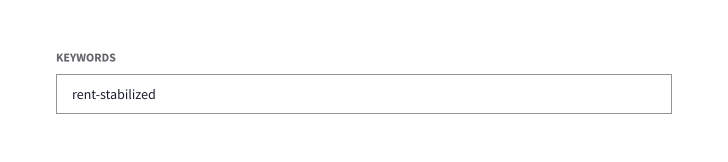
- Use the advanced search options on StreetEasy. You can search for rent-stabilized apartments on StreetEasy using keywords. Just click MORE next to the standard filters to bring up the advanced search options, then type “rent-stabilized” into the KEYWORDS field.

Benefits of rent-stabilized apartments
In addition to the locked-in affordability, there are other benefits of rent stabilization. These include:
Updates and improvements: As a tenant of a rent-stabilized apartment, you have the right to occupy a working, updated apartment. If the property manager fails to make proper updates to your apartment, you can file a complaint with the New York State Office of Homes and Community Renewal and ask for a reduction in rent until your property manager makes the required modifications.
Subletting: Tenants of rent-stabilized apartments may sublet their apartment, as long as the apartment is their primary residence.
Lease renewal rights: You can renew your lease every year or every two years.
Bankruptcy protections: Tenants of rent-stabilized apartments still have a right to their unit even if they declare bankruptcy.
Search for rent-stabilized apartments on StreetEasy →
Beyond rent control and rent stabilization, there’s a lot of important information that all renters in NYC should know. Visit our NYC Renters’ Rights: Resource Hub for Renters for more articles on your rights as a renter, the latest regulations, finding affordable housing, and more.